How big is the problem?
Bigger than most people think. EPA estimates put I/I at anywhere from 25 to 60 percent of all flow in sewer lines. In some systems, more than half of what the plant treats never needed treatment in the first place.
One industry estimate puts the excess flow cost at $3,000 to $8,000 a day for a 10 MGD plant. That's over $1 million a year spent treating groundwater and rain.
And it's not just money. When I/I spikes during a storm, it eats up capacity and can push a system toward overflows and compliance trouble.
Inflow vs. infiltration
- Inflow is surface water that gets in fast, usually during rain. Think holes in covers, roof drains, and bad connections.
- Infiltration is groundwater that seeps in slowly through cracks, failed joints, and deteriorating structures.
Manholes contribute to both. And with manholes spaced every few hundred feet, they add up.
Where concrete manholes leak
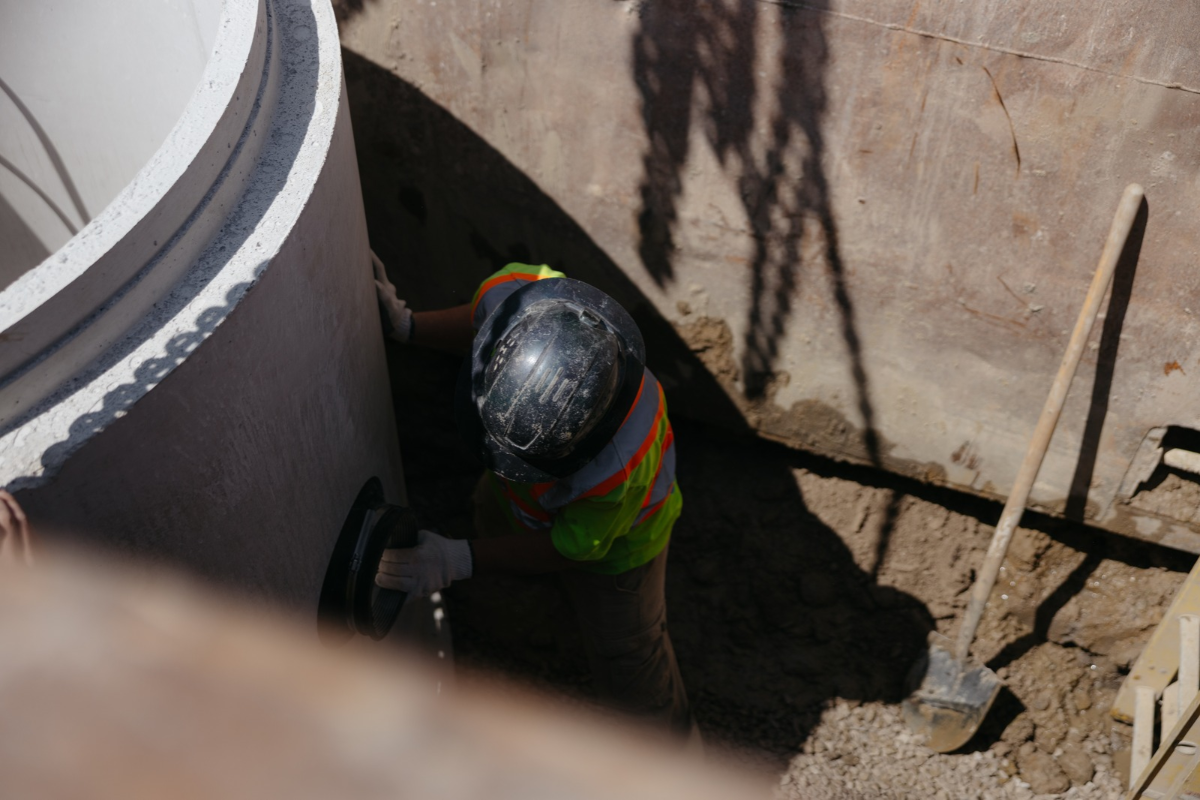
A precast concrete manhole is a stack of parts. Base, risers, cone, grade rings, frame, and lid. Every one of those connections is a potential leak path.
- Section joints. Each stacked section is sealed at the joint, and that's where infiltration usually starts.
- Grade rings and chimney. Frost heave, traffic loads, and ground movement push rings apart and crack the seal at the top.
- The concrete itself. Hydrogen sulfide turns into sulfuric acid that eats away at the walls. Rigid concrete cracks when the ground shifts. Both open paths for groundwater.
- Pipe penetrations. Field-cored openings and patched connections don't always seal as well as planned.
The longer a concrete manhole is in the ground, the more of these paths open up.
Fewer places for water to get in
The Poo Pit takes a different approach. It's rotationally molded as one seamless piece of high-density polyethylene. No stacked sections. No mortar joints. No precast seams.
- Seamless body: no section joints for groundwater to find
- Integrated seals: connections designed to stay watertight
- Corrosion-proof: hydrogen sulfide doesn't break down HDPE, so the walls don't degrade over time
- Flexible: absorbs ground movement and minor settling instead of cracking
- Configured to plan: inlets and outlets built to your angles and pipe sizes, so there's less field cutting and patching
Every joint you remove is one less place the problem can start.
Stop treating rainwater
I/I reduction usually means chasing leaks after the fact. Lining, grouting, sealing, and repeating it all a few years later. A better path is to install structures that don't leak to begin with.
When it's time to replace or add an access point, ask a simple question: will this structure add to my I/I, or help cut it?
Use the Poo Pit Calculator to find the savings: https://www.poopit.com/calculator